
Key Takeaways
Plastic business cards aren't for everyone, but for the right business they're one of the most memorable cards you can hand someone.
- Plastic cards are made from PVC. It's the same material used for credit cards, which gives you a sense of how they feel and hold up.
- They work best when the impression matters as much as the information. Nightlife, luxury brands, real estate, and creative professionals tend to get the most out of them.
- There are several finishes to choose from. Clear, frosted, and white plastic each create a different look and work better with different design approaches.
- Designing for plastic is different than designing for paper. Transparency, color contrast, and font legibility all need extra attention.
- They cost more than standard cards, but they last longer and get kept longer. For the right audience, the investment makes sense.
Most business cards get glanced at once and set aside, never to be seen again. A plastic business card tends to end up somewhere else. Still in someone's hand while they look at it a second time.
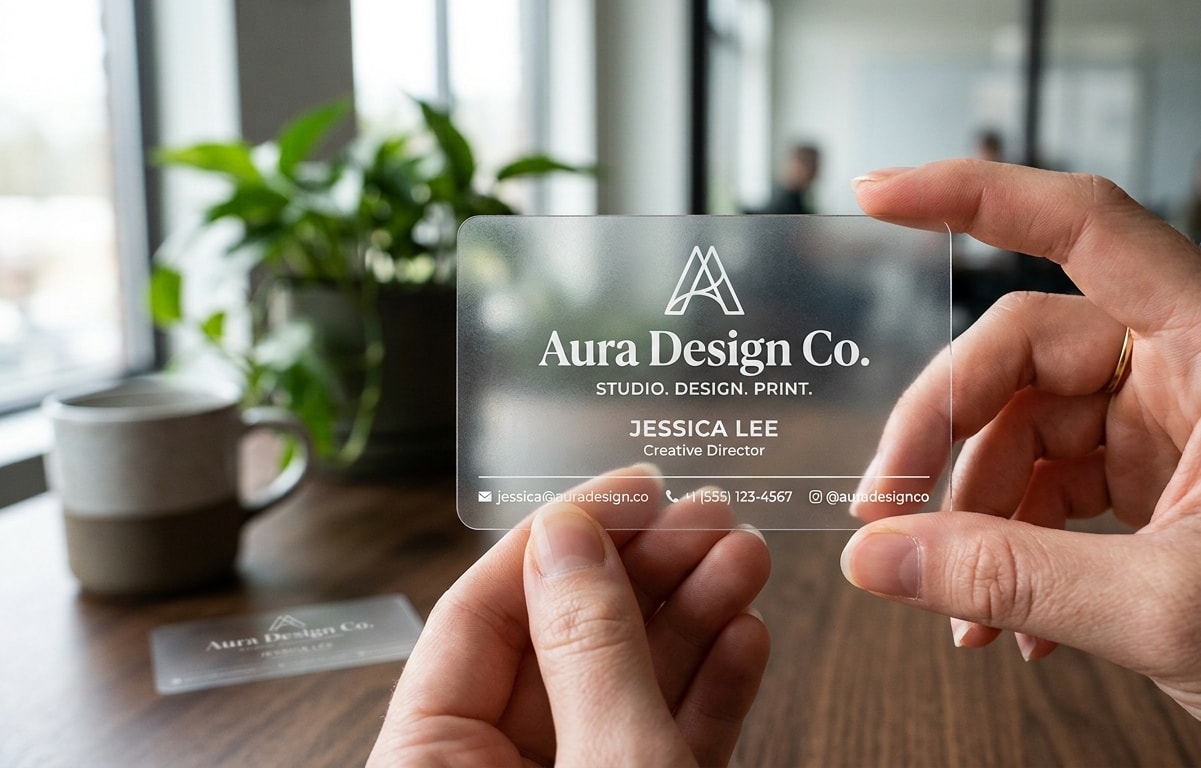
Plastic cards feel different the moment someone picks one up. The weight, the finish, the way light moves through a clear card all tell the person holding it that some thought went into the impression being made.
But plastic isn't the right call for every business or budget. Below, we’ll explaine what plastic business cards are, who gets the most out of them, the different types available, and what to think about before you order.
What Are Plastic Business Cards Made Of?
Plastic business cards are printed on PVC material, the same stuff used to make credit cards and loyalty cards. Pick up a credit card and flex it slightly. That's roughly what a plastic business card feels like in someone's hand.
They're printed differently than paper cards too. Instead of ink absorbing into the material, the design sits on the surface of the plastic. This affects how colors render and what design choices work best.
Standard plastic business card thickness runs around 20pt, a bit thinner than a standard credit card.
Who Should Use a Plastic Business Card?
Plastic cards work best when the first impression carries real weight. They're not a fit for every business, but certain situations are a natural match.
Nightlife and hospitality professionals deal with spilled drinks and crowded pockets on a regular basis. A plastic card survives that.
Luxury and high end brands benefit because the card does some of the positioning before anyone says a word. It feels premium because it is.
Real estate agents hand out a lot of business cards, and those cards live in pockets, purses, and car consoles for weeks. A card that still looks sharp after all that holds up better than one with bent corners and worn edges.
Creative professionals like designers and photographers often treat their card as part of the work itself. Plastic gives them more to work with visually.
If you want to be remembered at your next networking event, a clear plastic card makes you stand out before you even say hello.
The Different Types of Plastic Business Cards
There are three main finishes, and each creates a very different look. The right one depends on your brand and how you want the card to feel.
Clear Plastic
Clear is the most striking option. Light passes through the card, which creates a visual effect no paper card can match. Design elements appear to float, and white ink shows up with real contrast against the transparency.
Clear cards work best with minimal, well spaced designs. Too many elements and the card starts to feel cluttered.
Frosted Plastic
Frosted cards have a soft, translucent look that's more subtle than clear but still far more distinctive than paper. They tend to work well with lighter color palettes and clean typography.
The frosted surface also softens the look of fingerprints, which is a practical bonus.
White Plastic
White plastic is the closest to a standard card in terms of appearance, but noticeably different in how it feels. It gives you a full color printing surface similar to paper stock, with the durability and weight of PVC.
A good option for businesses that want the tactile upgrade without the transparency effect.
Design Tips for Your Plastic Business Card
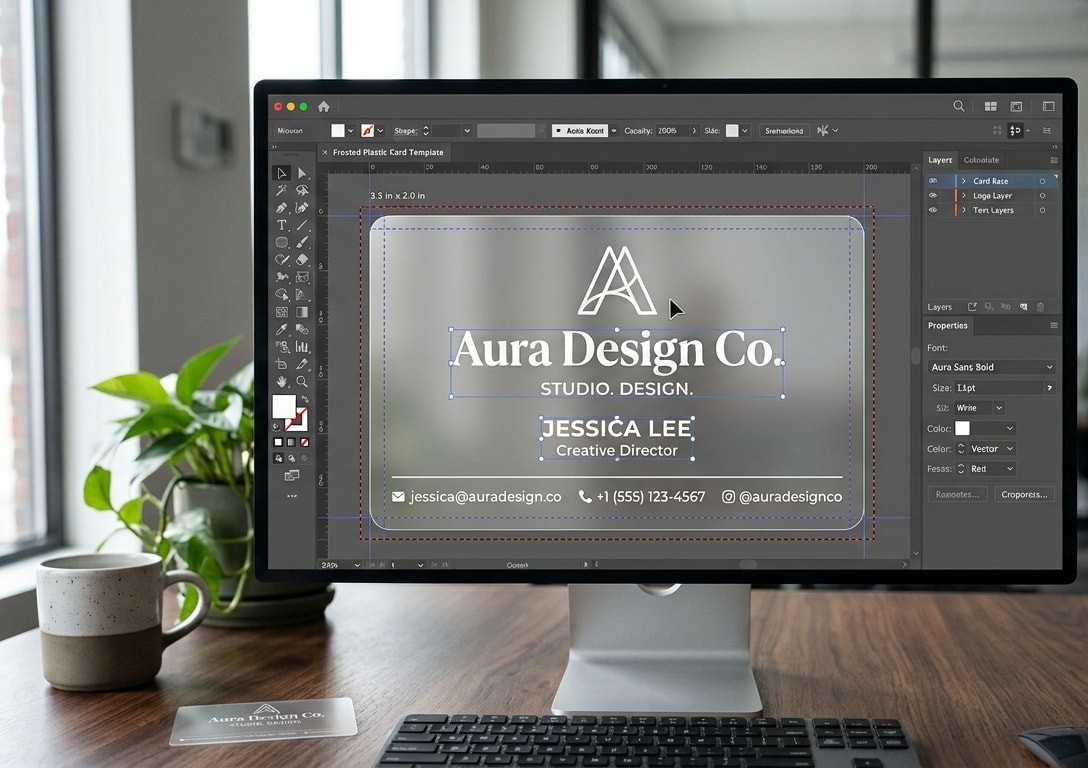
Designing for plastic takes a different mindset than designing for paper. A few things to sort out before you finalize anything.
- Transparency changes everything on clear cards. Whatever is behind the card becomes part of the visual. Keep designs clean and intentional, and lean on white ink for contrast.
- White ink is your friend. On clear and frosted cards, white ink makes text readable. Without it, light colored text can disappear against the transparency.
- Font choices matter more than usual. Fine serif fonts and very small type sizes can get lost on plastic. Stick to clean, legible fonts at a size that reads easily.
- Color renders differently on PVC. Colors tend to appear more saturated on plastic than on paper. Setting up your file in CMYK from the start helps keep colors as accurate as possible.
- Plan for the back. Clear and frosted cards are see through, so printing on both sides means the back design shows through the front. Plan for that intentionally or keep one side minimal.
What Should You Know Before Ordering?
There are a few practical things worth sorting out before you place an order.
- Budget. Plastic cards cost more than standard paper cards. For high volume handouts to a broad audience, plastic may not make sense. For a smaller number of cards where the impression really counts, the cost difference is easy to justify.
- Quantity. Most plastic card orders have minimums, often starting at 100 cards. Think about how many you actually need rather than ordering in bulk by default.
- File setup. CMYK color mode, 300 DPI resolution, and proper bleed are the basics.
- White ink in your file. If your design includes white ink, confirm with your printer how they want it set up. It needs to be handled as a separate layer in most cases.
- Turnaround time. Plastic cards typically take a little longer to produce than standard paper cards. If you have a deadline, confirm the turnaround before placing the order.
- Proof your work. Always proof your artwork before the job goes to print. Catching an issue early saves a reorder.
The Bottom Line
Plastic business cards aren't trying to replace paper cards across the board. They're a specific tool for a specific situation, and when that situation fits, they're hard to beat.
If your business is in an industry where first impressions carry real weight, or if you want a card that holds up and gets kept, plastic is worth the investment.
If you're not sure whether plastic is the right call for your brand, Print Cartel can help you think through the options and find the card that fits.
Frequently Asked Questions About Plastic Business Cards
Are Plastic Business Cards the Same Thickness as a Credit Card?
Most plastic business cards run around 20pt, which is a bit thinner than a standard credit card. It's noticeably heavier and more substantial than even a thick paper card stock.
Can You Write on a Plastic Business Card?
Not easily, and usually not at all on clear or frosted cards. The surface doesn't absorb ink the way paper does. If you need a card people can write on, a matte or uncoated paper stock is a better fit.
Do Plastic Business Cards Fit in Standard Card Holders and Wallets?
Yes. Plastic cards are cut to the standard 3.5" x 2" size, so they fit the same slots and holders as any other business card. The slightly thicker feel means a card holder fills up a little faster, but there's no functional difference in how they fit.
Are Plastic Cards a Good Fit for Every Industry?
Not always. They work best where the impression matters most, like luxury, real estate, nightlife, and creative fields. For industries where high volume and low cost matter more, a well designed paper card on quality stock is often the smarter choice.